
A teeth shade guide is a set of tooth-coloured samples that a dentist compares with your teeth when planning whitening, veneers or crowns. The VITA classical A1–D4 guide contains 16 shades in four colour families; the letters are not a simple light-to-dark ranking. Choosing a shade means considering brightness, colour intensity and neighbouring teeth, not picking the first code on a chart.
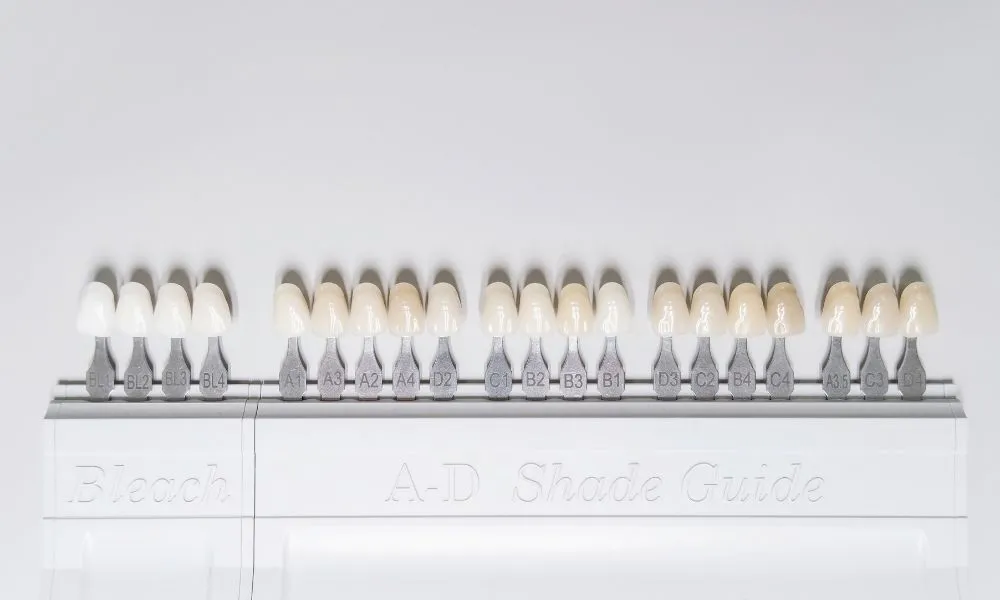
What do A1–D4 tooth shade codes mean?
The letter describes a colour family, or hue. The number distinguishes samples within that family. VITA’s classical guide includes the following codes:
- A — reddish-brownish: A1, A2, A3, A3.5 and A4.
- B — reddish-yellowish: B1, B2, B3 and B4.
- C — greyish: C1, C2, C3 and C4.
- D — reddish-grey: D2, D3 and D4.
There is no D1 tab in this 16-shade guide. A3.5 is a separate sample within the A family, not a score for how healthy a tooth is. A tooth’s appearance also depends on translucency and differences between its neck, middle and edge, so one code does not describe every detail of a natural tooth.
Is A1 or B1 whiter?
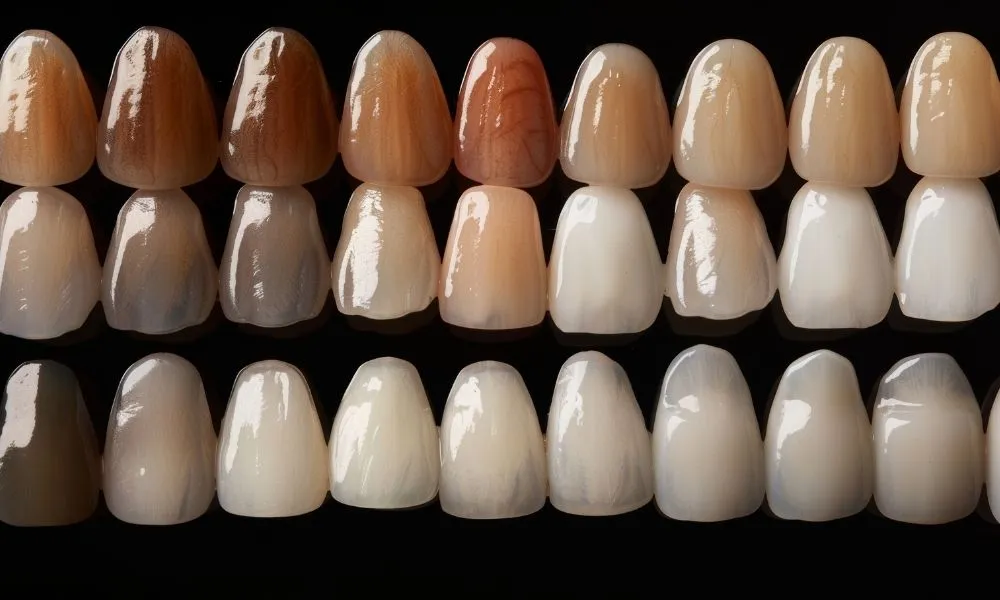
B1 is lighter than A1 in the commonly used brightness-based arrangement of VITA classical tabs. A1 belongs to the reddish-brownish family and B1 to the reddish-yellowish family. Comparing only the letters or numbers gives the wrong impression: A1 does not mean “whiter than every B shade”.
This comparison describes reference samples, not a promise that whitening can make your teeth B1 or that B1 is the right restoration colour for you. Your dentist compares actual tabs beside your teeth under suitable lighting. For a single visible crown, matching nearby teeth may matter more than selecting the lightest sample.
How dentists read a dental colour chart
Three terms explain why a shade chart is more than a row of whites:
- Hue: the colour family.
- Chroma: how strong or saturated the colour appears.
- Value: how light or dark it appears.
The alphabetical A–D layout groups colours by hue; a brightness-based layout puts them in a different order. A screen image or printed home chart is useful for understanding the names, but screen settings, camera processing and lighting make it unsuitable for selecting an exact treatment shade.
Classical, 3D-Master and digital shade guides
VITA classical uses the 16 A–D samples listed above. VITA 3D-Master uses a different coding system organised around lightness, colour intensity and hue. Bleach shades are additional very light reference shades; their labels depend on the guide. A code from one system should not be treated as an exact equivalent in another without checking the appropriate reference.
Digital shade devices can support measurement and communication with a laboratory. They do not make visual checks, correct use or appropriate lighting unnecessary. Ask which system your dentist is using, especially when comparing a natural tooth with ceramic crowns or veneers.
Which tooth shade is normal or most common?
There is no single shade that every healthy smile should have. Natural teeth vary, and a shade code is not a diagnosis. A3 is one reference sample; calling it the universal “most common” or best shade would require evidence for a defined population. Do not use a colour chart alone to decide whether your teeth need treatment.
Teeth can become darker with age, staining drinks or smoking, but that does not establish which restoration shade suits an individual. A sudden change in one tooth’s colour, pain or other symptoms should be assessed by a dentist rather than hidden with a cosmetic shade choice.
Choosing a shade for whitening, veneers or crowns
Whitening natural teeth
A guide can record the starting shade and help discuss a realistic goal. Teeth whitening lightens natural teeth; it does not make an existing crown or veneer change to the new shade. If you have restorations in the smile line, discuss possible colour differences and the treatment sequence before starting. Your teeth and gums should be checked first.
Matching a single crown or veneer
Compare the proposed shade with adjacent teeth, including their translucency and surface appearance. The underlying tooth and restorative material can influence the final appearance. A very bright tab that looks attractive on its own may stand out beside untreated teeth.
Planning several visible teeth
For porcelain veneers, laminate veneers or a wider smile makeover, discuss your preference for a subtle or brighter appearance and the teeth that will remain untreated. There is no fixed shade prescription based on skin colour, age or occupation. Cosmetic preferences do not replace checking tooth health and treatment suitability.
What to ask at a shade consultation
- Which shade system are we using, and what do its codes mean?
- Are we matching neighbouring teeth or changing the appearance of several teeth?
- Will whitening leave a colour difference beside my existing restorations?
- How will the chosen material and underlying tooth affect the final appearance?
- Can I assess the proposed appearance before irreversible treatment, and what can still be adjusted at that stage?
Bring your questions to a consultation. The useful outcome is a documented, individual shade decision—not a universal “best white” or a guaranteed number of shades lighter.
Further reading
- VITA Zahnfabrik: VITA classical A1–D4 shade guide — manufacturer description of the colour families.
- Dentalcare professional education: VITA classical shade selection — hue, chroma, value and the brightness-based tab arrangement.
- NHS: teeth whitening — natural teeth, suitability and professional assessment.