Unique Smile Turkey




An upper jaw is structurally different from the lower jaw. It consists of a lighter, more porous, and softer bone. When patients have their natural teeth, the upper jawbone is stimulated daily. When teeth are lost, this stimulation disappears and the jawbone gradually resorbs over time. With Antalya dental implant treatment, the bone is stimulated again and bone volume increases.
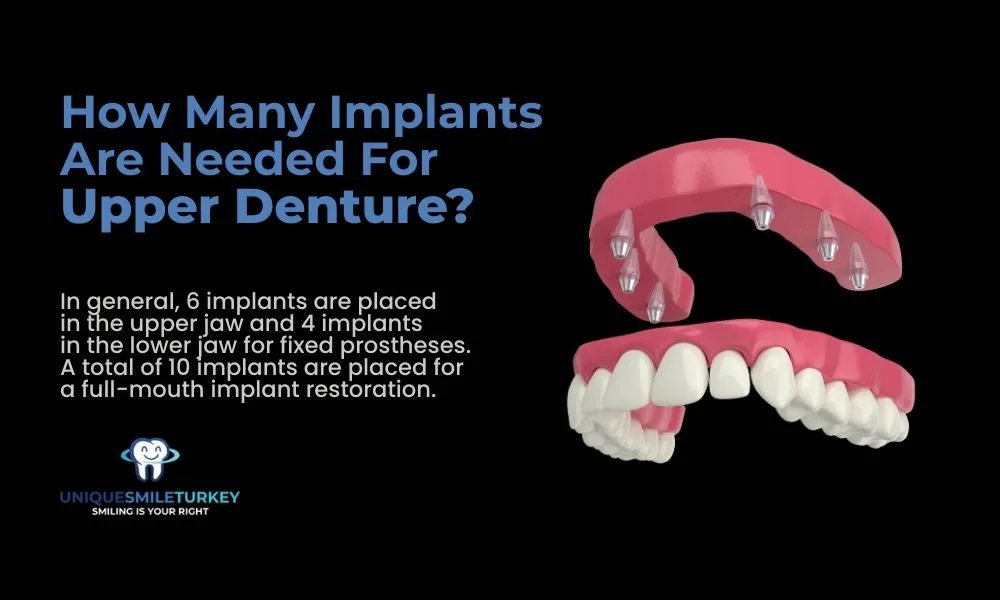
The upper jawbone requires more implants than the lower jaw. In addition, the same implant treatment is not applied to every patient. The number and position of implants are strategically determined for each individual patient. However, in general, 6 implants are placed in the upper jaw and 4 implants in the lower jaw for fixed prostheses. A total of 10 implants are placed for a full-mouth implant restoration.
The dentist evaluates the width, height, and density of the bone using three-dimensional imaging and radiological examinations. They also examine the occlusion of the upper and lower jaws. This is because implants must adapt not only to the bone but also to the patient's bite pattern.
A patient with strong chewing muscles places significantly more load on implants. The number of implants placed in a patient who chews with less force may differ from the number placed in such a patient.
Additionally, the shape of the teeth to be made also affects the planning. If there is a wide smile line, a long dental arch, or a strong need for chewing in the posterior region, more implants are required to distribute the forces evenly. Planning aims to anticipate not only the day of surgery but also function years later.
The bone volume in the upper jaw is naturally low. In addition, after tooth extractions, the bone begins to resorb both vertically and horizontally. During the same period, the maxillary sinuses expand and occupy the area previously filled with bone. In some patients, there is sufficient bone remaining for implant placement. In others, implants must be placed at an angle into the more solid anterior bone. In some cases, bone grafting procedures are performed to rebuild the lost volume.
When bone is limited, increasing the number of implants is sometimes safer. The goal is to spread the pressure over a wider area rather than placing excessive load on weak bone. You can think of it like trying to avoid sinking by spreading your weight when walking on soft ground.
If I may offer a tip, placing implants as soon as possible after tooth extraction is a good choice. Treatment with fewer implants while the bone is still strong offers advantages.
Gum disease weakens the protective barrier around the implant, even if the bone is healthy. This barrier is the most important defence against bacteria reaching the bone.
In patients who have previously experienced gum disease, the tissues must be stabilised before implant placement. This process may involve professional cleaning, follow-up, and sometimes minor soft tissue adjustments. Thick and healthy gum tissue facilitates cleaning and creates a more durable structure around the implant. Even if gum disease is controlled, more implants may be needed if bone loss has occurred.
Each patient's chewing force is different. Some bite very hard, and in those with nighttime teeth grinding or clenching habits, this force increases significantly.
Implants lack the periodontal ligament that acts as a shock absorber in natural teeth. Therefore, the force is transmitted directly to the bone. When there are insufficient implants, each implant has to bear more load. Over time, this leads to mechanical wear or bone loss. Increasing the number of implants distributes the force over a wider area. Thus, the system becomes balanced, similar to how natural teeth work together.
Patients often believe that fewer implants mean easier treatment. Clinically, this is not always true. While placing a minimum number of implants may seem simpler initially, it creates more stress on the implants in the long term.
Another misconception is that a specific number of implants is suitable for everyone. However, treatment should be tailored to each patient's anatomy. A plan suitable for a patient with dense bone will not yield the same results in a patient who has used prostheses for years and experienced significant bone loss.
Sometimes adding one or two implants significantly increases the durability of the entire system. The goal is not to expand the treatment, but to make the foundation secure.
Snap-in (removable implant-supported) dentures work on a different principle than fixed bridges. Since these dentures continue to derive some support from the gum tissue, they generally require fewer (two) implants than fixed restorations.
In the upper jaw, four implants are usually the starting point. However, in many cases, five or six implants are preferred for better balance and stabilisation. Increasing the number of implants makes the prosthesis feel more secure, reduces wear on the connecting parts, and balances the pressure on the gums.
The number of implants in the upper jaw is never determined randomly. The deciding factor is not the number; it is the combined assessment of anatomy, biology, and function. Proper planning aims not only to replace teeth but also to create a foundation that will function healthily for years to come.
If you are planning to get All-on-4 and All-on-6 dental implants, contact our dental clinic, Unique Smile Turkey, in Antalya. Have a healthy day.